Published on
By Evan Johnson | Bond LSC
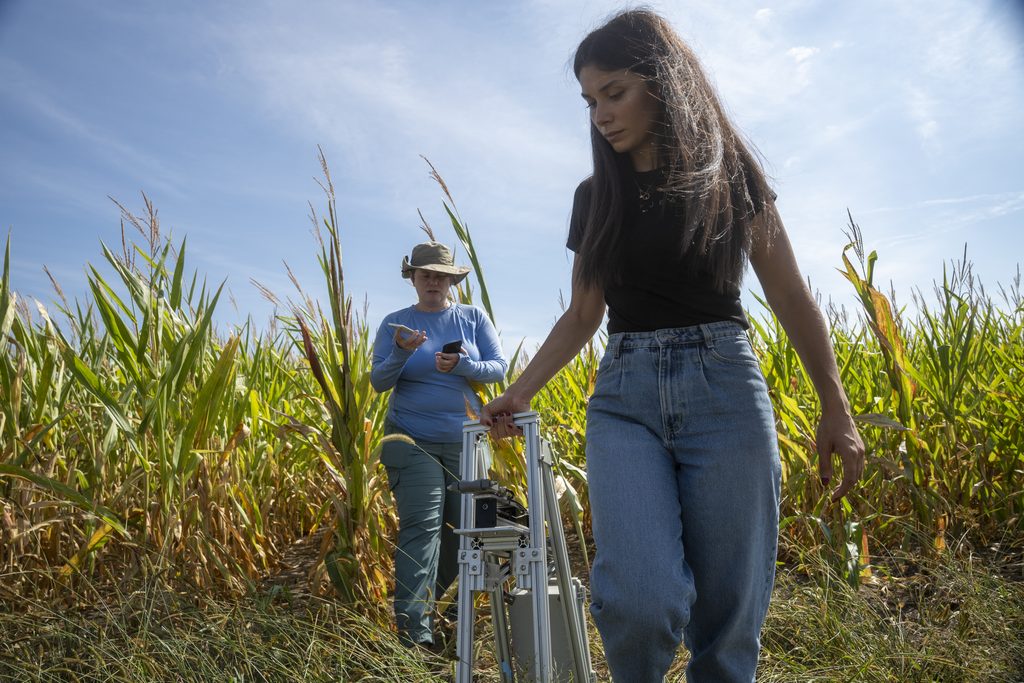
Between drying rows of corn at Mizzou’s South Farm, Anna Siosiou uses a small, mechanical arm to push against corn stalks to measure their strength.
The visiting Fulbright scholar from Thessaloniki, Greece, tests how the row crop anchors itself to withstand the elements to make it to harvest upright. Working in the lab of Erin Sparks, a Bond Life Science Center and Donald Danforth Plant Science Center principal investigator, together they research how different nitrogen treatments affect corn stalk stability.
“Farmers in the U.S. and in Greece face similar challenges,” Siosiou said. “My main goal is to find mechanisms that can improve intercropping systems to help with food accessibility, plant health and the environment.”
Current economics mean fertilizer prices that are higher than ever, and farmers are pinched to turn a profit. Data from the Sparks lab may help improve corn stability and minimize the amount of nitrogen or “input” required for a successful harvest, easing financial strain on farmers.
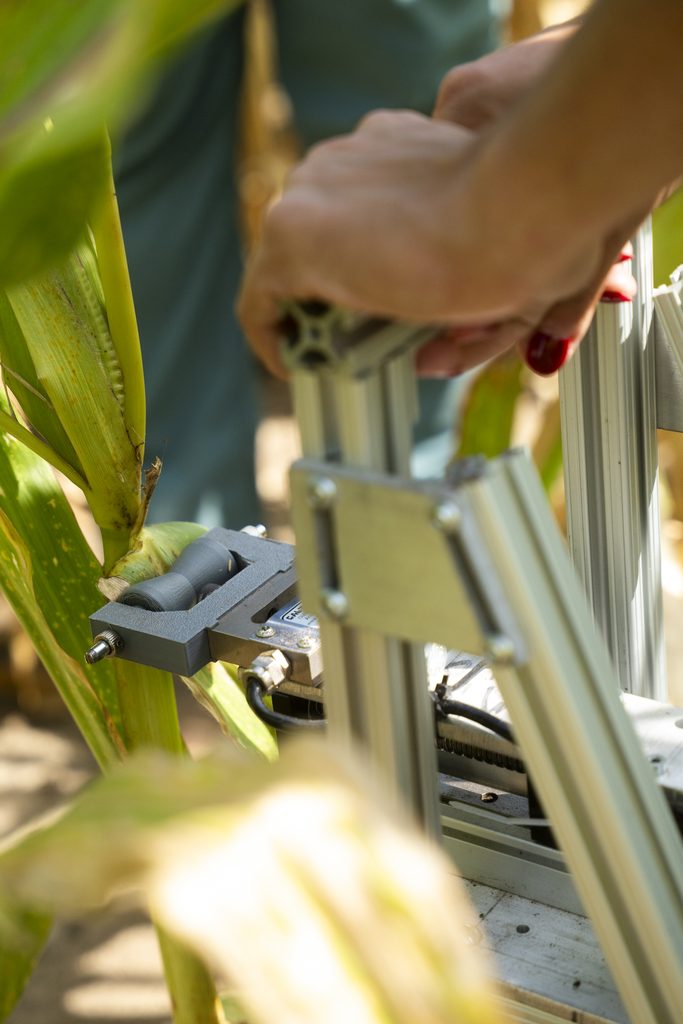
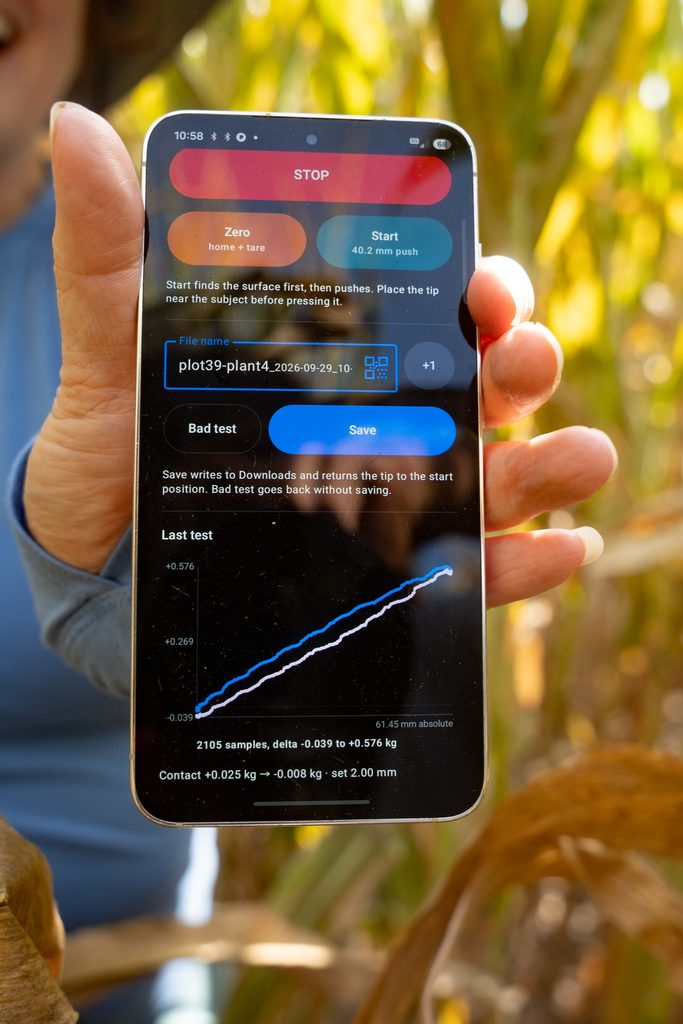
Siosiou uses a tool custom made by the Sparks lab to measure corn stalk stability. Its small, mechanical piston puts pressure on the stalk and measures resistance or “force by displacement.” Information collected from the device is sent to an app that allows the team to visualize the strength of the stalk through a line slope. By comparing the data from different plots of corn, the Sparks lab is able to determine how differing fertilizer treatments had an effect on the strength of the plant.
Findings from their research point to “split nitrogen” treatment being an increasingly viable option for crop treatment, where farmers apply two nitrogen treatments in a year, rather than one large application.
“A lot of what we do is figuring out the consequences of these decisions and to make sure that these decisions aren’t making your crops more susceptible to falling over,” Sparks said. “What we want to understand is can a farmer reduce their nitrogen and not worry about the plants breaking.”
The Fulbright Foreign Student Program brought Siosiou to the Midwest for six months from her native Greece. The program brings around 900 faculty and professionals from more than 100 countries around the world to the U.S. each year for advanced research and university lecturing. Siosiou currently is a PhD candidate studying agroecophysiology at the Aristotle University of Thessaloniki, and analyzing the symbiotic and competitive relationship between plants, and she chose the Sparks lab for its overlap with her current research.
“I saw that we have common interests and passion for the field and when I asked her to be my host she never hesitated once. I found Mizzou was an excellent university with a stunning campus and many honors, and people working here seemed very passionate and put effort into science. In my 3rd year of my PhD, which is almost to the finish line, I want to meet as many people as I can that can inspire me even more to what I can become as a scientist.”
By the time Siosiou returns to Greece, she will bring a little more knowledge about corn resilience in the field to benefit her home.
“The scope is to help farmers, and in general, to help with food accessibility, plant health, and the environment. It’s a cycle. If you help the farmer, you’re helping the community at the end of the day.”